
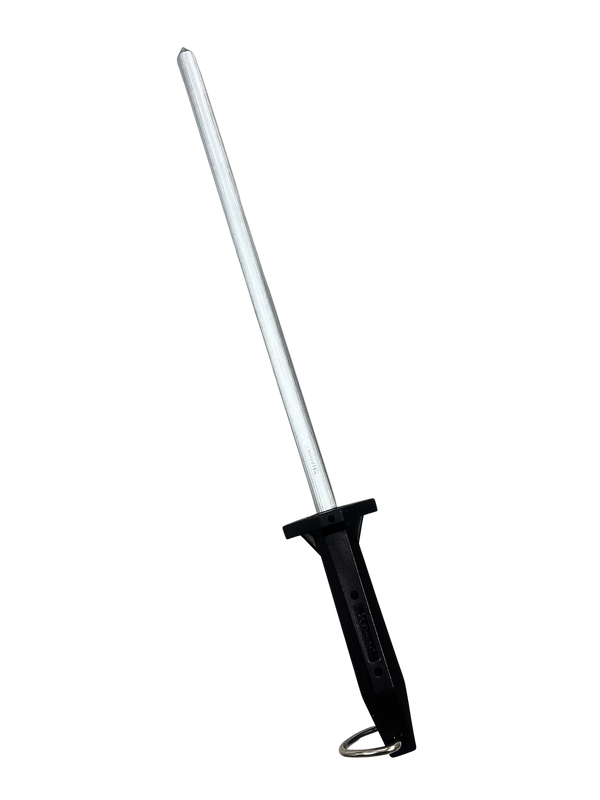
Sharpening Steel
$44.00
Description
Function:
- Used to realign the edge of a knife blade and maintain its sharpness between actual sharpenings.
- It doesn’t remove much metal like a whetstone or grinder does; instead, it straightens and smooths the microscopic edge of the blade that bends during use.
- Common in kitchens to quickly “hone” knives before or after cutting tasks.
Here’s a step-by-step guide to safely using a sharpening steel:
1. Position Yourself
Stand with your feet shoulder-width apart. Hold the sharpening steel vertically in your non-dominant hand. Rest the tip on a cutting board or a non-slip surface for stability (never free-swing in the air if you’re not experienced).
2. Hold the Knife Correctly
Use your dominant hand to hold the knife by the handle. Position the blade at a 20° angle against the steel (for most Western kitchen knives; Japanese knives often use 15°).
3. Hone One Side
Starting near the heel of the blade (closest to the handle), draw the knife downward and toward you, sliding from heel to tip along the steel. Maintain the same angle during the entire motion.
4. Hone the Other Side
Switch sides by placing the blade’s other face against the opposite side of the steel. Draw the knife downward and away from you this time, again moving from heel to tip.
5. Repeat Evenly
Alternate sides for 5–10 strokes each. Keep pressure light; you’re aligning the blade, not grinding it.
6. Safety Tips
Always move the knife away from your body. Keep fingers of your non-dominant hand behind the guard of the steel handle. Ensure the steel’s tip is stable — if it slips, you risk cutting yourself. After honing, wipe the blade with a clean cloth to remove any microscopic metal shavings.
Reviews
There are no reviews yet.